





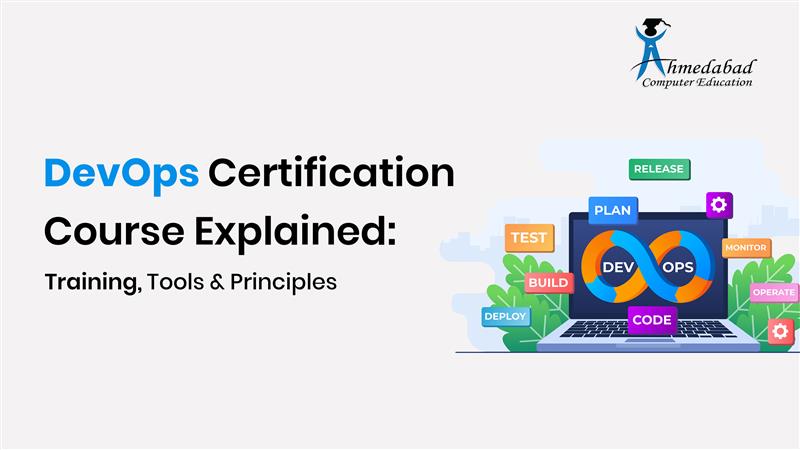
DevOps Certification Course Explained: Training, Tools, & Principles
Today’s tech landscape is evolving too rapidly. Hence, enterprises and businesses cannot achieve success with isolated IT operations and software development teams. Only by working hand in hand can they deliver faster, more reliable, and higher-quality solutions. Now enters DevOps —a technological and cultural transition meant to bridge the gap between development and operations. Its significance has grown rapidly as businesses now seek agile, efficient, and seamless collaboration in delivering software-based products.
Given this, enrolling in a reputable DevOps certification course will make a real difference in your future career. It will not only help you gain knowledge about different principles but also accelerate your transition to becoming a DevOps specialist. This being said, let’s explore the core concept of this techno-cultural concept and why it has become a game-changer for organizations across the world.
What is DevOps?
Consider DevOps as a comprehensive set of multifarious practices, cultural philosophies, and tools designed to automate and integrate processes concerning IT operations and software development. Right at the core, its goal is to foster seamless collaboration, accelerate software delivery, and ensure continuous improvement.
Here’s a brief overview of DevOps’s history and evolution.
- 2000s: Emphasis was given on Lean and Agile principles for speeding up development cycles.
- 2009: The term “DevOps” was coined to address the sheer lack of collaboration between development and operations.
- 2010: Witnessed the rise of automation tools, CI/CD pipelines, and the adoption of cloud computing.
- Today: Integrating monitoring, security (DevOps Sec), feedback loops, and continuous delivery for streamlined end-to-end software project management.
Why Does DevOps Certification Matter?
In today’s era, organizations are rushing towards delivering reliable and high-performing software products with shorter time to market. That’s why professionals are now looking for a reputable DevOps certification course. It will help individuals validate their expertise in tools, practices, and cultural principles that drive this transition.
For employers, on the other hand, it signifies employees possess the necessary skills essential to streamline workflows, foster collaboration, and implement automation.
Key Benefits of DevOps Certification
- Career advancement: Certified DevOps professionals enjoy excellent salaries, faster promotions, and easy access to senior roles in both software development and IT sectors.
- Industry recognition: With the DevOps certification course, one can demonstrate immense credibility and higher technical proficiency, thereby standing out in the competitive market.
- Practical skills: Training will equip learners with hands-on experience in CI/CD, cloud platforms, monitoring tools, and containerization.
- Networking opportunities: Certification programs also offer easy access to communities, industry events, and forums for knowledge sharing and gaining valuable industry insights.
Who Should Consider a DevOps Certification Course?
- Software developers and IT Operations professionals
- Career switchers and freshers
- Cloud engineers and system administrators
Core DevOps Principles
Collaboration and Communication
DevOps emphasizes teamwork amongst developers, operations teams, and quality assurance professionals. With a transparent and continuous communication channel, people can share responsibilities, align goals, and resolve conflicts faster and with promptly. This philosophical culture completely breaks traditional silos, thereby creating a unified workflow. Thus, everyone can contribute to achieving high-quality, efficient software delivery.
Continuous Integration and Delivery (CI/CD)
At the heart of DevOps principles lies CI/CD, which, when combined, promise more reliable and faster releases.
- Continuous Integration: Code merges occur more frequently to ensure early detection of issues and prompt resolutions.
- Continuous Delivery: Automation of deployment cycles to allow production-ready software delivery at any time.
Together, these can shorten the overall release cycles while maintaining consistent product quality.
Automation and Monitoring
Automation can eliminate repetitive tasks from software development projects. Hence, accuracy and speed can be enhanced across all phases of the release cycle. Here’s how.
- Enables efficient configuration management and infrastructure provisioning
- Fosters real-time monitoring to track system health and detect issues early before they escalate
When combined, these principles can ensure reliability, stability, and proactive performance management throughout the software lifecycle.
Feedback and Iterative Improvement
DevOps emphasizes the significance of continuous learning through optimized feedback loops from systems, users, and teams. Valuable insights gained from this can drive refinement in both products and processes. To top it off, iteration and regular improvements will help organizations become more adaptive, responsive, and innovative to dynamically evolving consumer needs.
Key Components of DevOps Training
A meticulously structured DevOps certification course will guide students to transition smoothly from foundational to advanced levels. This ensures they can gain both conceptual understanding and practical expertise in this techno-cultural field. Such courses typically begin with explaining the core principles and gradually move towards advanced automation and deployment strategies.
Below are the key topics usually included in DevOps training for beginners.
- Technologies & tools: Git, CI/CD pipelines, Jenkins, Kubernetes, Docker, Terraform, and Ansible.
- Practical learning: Hands-on lab sessions and simulations of real-world environments to help students implement concepts like containerization, automation, and monitoring strategies.
- Real-world projects: Learners can work on industry-based scenarios to harness end-to-end project experience.
Job Opportunities After DevOps Training
Completing the DevOps training for beginners unlocks stellar job opportunities with high-demand IT roles. These include:
- Release manager
- DevOps engineer
- Automation expert
- Build engineer
- Cloud architect
Some of the key industries that are hiring DevOps professionals include fintech, e-commerce, IT, healthcare, and telecommunications. Salary expectations also improve once you complete the DevOps certification course, like:
- Entry-level professionals: INR 6 to INR 8 LPA
- Mid to senior level: INR 15+ LPA
Conclusion
Enrolling in a DevOps certification course at Ahmedabad Computer Education is indeed a smart, intelligent move to thrive in today’s tech landscape. With it, you can validate your skills, improve your credibility for employment, and gain access to better career opportunities. So, wait no longer and take the first step so that you can build future-ready skills in no time.